Children’s Right to Arts and Culture
When was the last time you took a baby to an art gallery? Or let a three-year-old decide which painting was worth looking at? You might be surprised by their choices. Apparently, a portrait of former Prime Minister Harold Wilson can be utterly fascinating to a three-year-old. Who knew?
This was one of the delightful stories that emerged from my latest Talking Early Years podcast with Dr Nicola Wallis, Early Years Programme Manager at the National Portrait Gallery, and Catherine Ritman-Smith, Head of Learning and Engagement at Young V&A. We recorded the conversation to celebrate World Children’s Day on 20 November, particularly Article 31 of the UN Convention on the Rights of the Child, which recognises children’s right to play, rest and participate in cultural and artistic life.
The question is whether we take that right seriously for our youngest citizens.
Why children’s access to arts and culture matters
I have long argued that access to arts and culture is a social justice issue. Museums, galleries and cultural spaces belong to all of us, yet too many families feel they are not places for people like them. I remember my own father, who didn’t visit an art gallery until his late sixties, suggesting that such places were for posh and clever people. It took my sister becoming an art student to disabuse him of that idea. And we must be careful not to treat arts and culture as luxuries that families can enjoy only when everything else in their lives is sorted. Children living in poverty have just as much right to beauty, creativity and cultural experiences as anyone else. Indeed, these opportunities may matter even more when life is difficult.
Cultural experiences and discovery in the Early Years
But those attitudes matter. If adults don’t feel welcome, how will children ever get through the door? Nicola introduced the lovely idea of cultural awakening, recognising that babies are already making sense of the world through people, places, objects and experiences. They don’t need us to simplify everything into brightly coloured, supposedly child-friendly activities. Sometimes they are captivated by beautiful buildings, unusual objects or the patterns on the floor. Perhaps the most important lesson is that we need to stop deciding what children should find interesting and give them the freedom to discover what fascinates them. That’s children’s agency in action.
Making museums and galleries welcoming for young children
Catherine described how Young V&A has worked to make its museum genuinely welcoming to young children and families. Both guests reminded us that cultural organisations have a responsibility not simply to open their doors but to welcome them and help people feel they belong.
The role of Early Years teachers in bringing culture to children
There was also a powerful message for Early Years teachers. At LEYF, we take apprentices to museums because adults need cultural confidence too. One of my favourite moments was hearing from our manager at Soho describe success as parents who had first visited a gallery with the nursery having subsequently returned independently. That is social justice in action. Families beginning to feel that the city and its cultural treasures belong to them.
Making arts and culture accessible to every child
Of course, not everyone lives near a national museum. But culture is everywhere: local museums and galleries, music festivals, community events and libraries. Nicola told us about finding the Landbeach Tithe Barn in rural Cambridgeshire which became a favourite place for the local nursery. I visited a National Trust house this summer and met the loveliest childminder with her assistant and four little 2-year-olds who had driven over from Bristol to visit and were delighted by the whole experience. It brings to mind Nicola’s wish for every cultural organisation to build lasting relationships with local nurseries and childminders, rather than relying on occasional visits. Catherine imagined a national Early Years cultural day. I like both ideas, although why stop at one day?
Celebrate World Children’s Day: take a child somewhere cultural
So here is my challenge for World Children’s Day. Take a child somewhere cultural, discover something beautiful together, or create your own art gallery. Better still, visit a museum yourself, simply for the pleasure of it and celebrate with tea and cake afterwards!
Listen to the podcast and join us in asking a simple question: if culture belongs to everyone, why aren’t we making sure every child experiences it from birth?
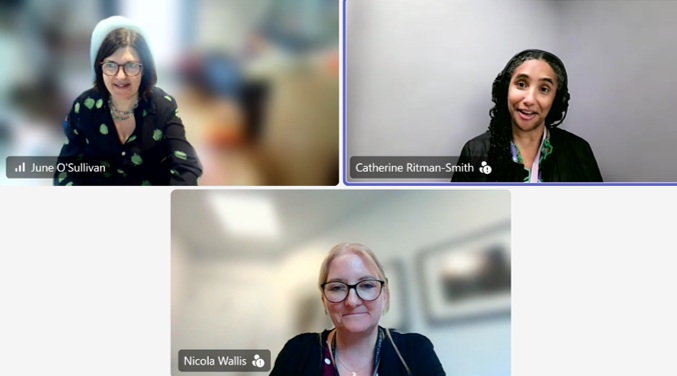
Catherine Ritman-Smith, Head of Learning at Young V&A
Nicola Wallis, EY Programme Manager at the National Portrait Gallery