
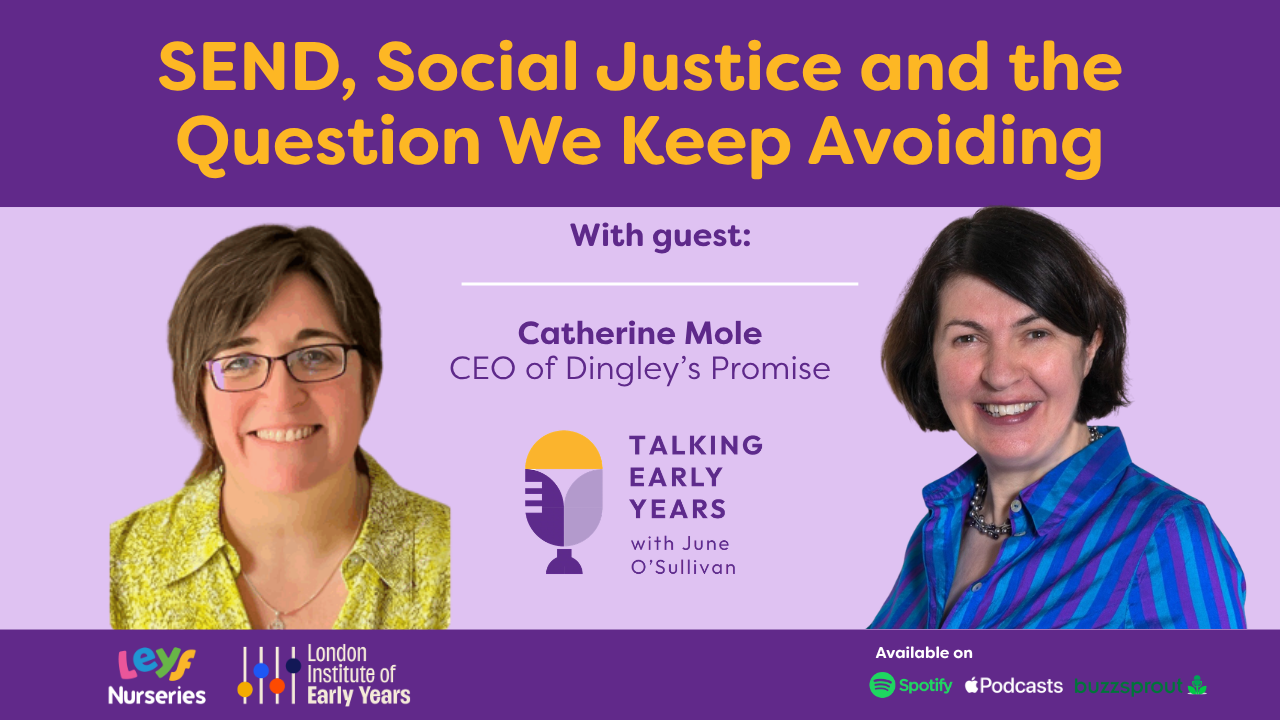
SEND, Social Justice and the Question We Keep Avoiding
Everyone is talking about SEND. Inclusion. Rising need. Pressures on schools and nurseries. But I’m not convinced we all mean the same thing when we…
Child poverty is about more than household income. In this conversation, Baroness Ruth Lister explores how poverty affects children's dignity, belonging and participation, and why their experiences should help shape policy.
October 16th 2026
Child poverty in Britain today isn’t what most people think it is.
Around 4.5 million children in the UK are living in poverty. Yet poverty is not always immediately visible. It is not necessarily a child without shoes or food. It can be the child who cannot go to the birthday party, have the right school shoes, join the school trip or take part in the ordinary experiences that allow children to feel that they belong.
That is one of the reasons poverty can be so difficult to recognise. It shapes childhood not only through material hardship, but through exclusion, shame, restricted choices and missed opportunities. For those of us working with children and families every day, these experiences are painfully familiar. We see parents stretching every penny, making impossible choices and often sacrificing their own needs to protect their children.
We also know that some of the old stereotypes about poverty no longer fit. Having a job does not necessarily provide protection from poverty. Low pay, housing and other essential costs, family circumstances and the adequacy of financial support all matter.
There has, however, been an important shift in the national conversation. The Government’s Our Children, Our Future Child Poverty Strategy sets out a ten-year ambition to tackle child poverty by increasing family incomes, reducing the cost of essentials and strengthening local support. The abolition of the two-child limit, expansion of free school meals and other measures represent significant interventions.
So perhaps the question now becomes even more important: what will success look like through the eyes of a child?
Reducing the number of children below an income threshold matters enormously. But Baroness Ruth Lister’s work has long challenged us to understand poverty as something children experience, not simply something economists measure.
In this episode, I sit down with Baroness Ruth Lister of Burtersett, one of Britain’s leading voices on poverty and social policy, to explore what relative poverty really means, why children’s own experiences and voices should shape policy, and why tackling poverty is about more than income.
We talk about dignity, belonging and participation: the things that allow a child not simply to survive childhood, but to participate fully in it.
And at a moment when government has made reducing child poverty a national priority, this conversation feels particularly timely. The challenge now is to ensure that policy change reaches all the way into children’s everyday lives.
Because ultimately the test is not simply whether the statistics improve. It is whether childhood improves.
Join us for a thoughtful and ultimately hopeful conversation about what it will take to create a fairer childhood for every child.
Everyone is talking about SEND. Inclusion. Rising need. Pressures on schools and nurseries. But I’m not convinced we all mean the same thing when we…
Why listen to this episode? Hear directly from Professor Barbara Rogoff on sociocultural learning and how children learn through participation Explore why culture and…
The Early Years as a Political Space Early childhood education is not a neutral or technical service—it is a deeply political space and this is the focus of…