
AI, Care and the Curriculum: Where Should We Draw the Line?
I was delighted to sit on a panel at the Childcare Expo to discuss artificial intelligence (AI), a subject that has been gathering momentum across the media, not least…
December 8th 2025
On the 17th of November, I was invited by the Royal Foundation, Centre for Early Childhood to a lecture by Professor Robert Waldinger from Harvard University, who co-wrote the letter with the Princess of Wales earlier this year. Their essay, entitled The Power of Human Connection in a Distracted World, warns that smartphones and other screens have contributed to an epidemic of disconnection, despite the promise that technology would keep us connected. They argue that instead, technology and screens have fragmented our focus so that we can be physically present but mentally absent even when we are with family or children. Drawing on decades-long research from the Harvard Study of Adult Development, the essay emphasises that the most powerful predictor of a healthy and fulfilling life is the quality of our relationships and meaningful human connection not health metrics or material success.
The lecture was along similar lines but also drew on the World Happiness Report which shows that although we are getting richer, our well-being is declining. As director of the Harvard Study of Adult Development, which is the longest running study which started in 1938, he had plenty of stories to highlight the challenges of the past 87 years, reminding us that when the study began there was no DNA or MRI scans. As per the slide, the things that are consistently aligned to happiness are social support, generosity of spirit and trust. In the Early Years, this translates to parents wanting knowledgeable, compassionate support from trusted teachers who have time to talk to them. This of course reinforces the power of the conversation, something I believe strongly is a key anchor of learning.
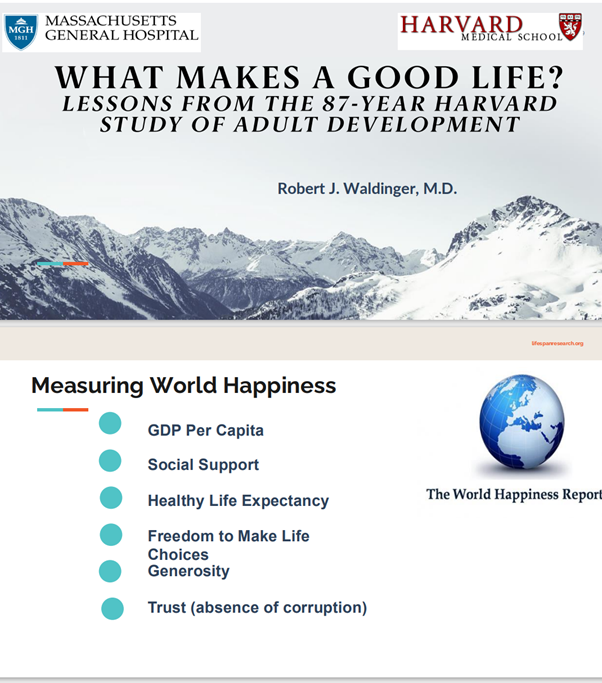
Interestingly, when they asked young 30-year-olds what they thought were their important goals, they listed three main goals which disconnect them from the world happiness findings :
Underlying this was the power of subliminal, and active marketing messages accelerated by social media. These messages distort the actual science of what are the real ingredients for happiness and the technology driven messaging focuses us more on owning things and comparing our lives to others. He said that comparison is the thief of joy and what is happening is that we are always comparing our insides to other people’s outsides, especially on social media.
It is also contributing to the fast-growing modern problem of loneliness which is as bad for you as smoking 1/2 a packet cigarettes every day or even having untreated hypertension.
Loneliness is highest in young people aged between 16 and 24, followed closely by those who live on low incomes. According to his report, 25% of us have no one to confide in, 35% of us have stopped inviting people into our homes and there’s been a 43% drop in family dinners. Only 30% of people said they had a best friend at work (someone to chat, eat lunch and have a laugh with) and one in 12 were less engaged, less productive, and had poorer well-being. Connections at work were considered very important, something that needs revisiting given the working from home narrative. Paying attention is the most basic form of love or as Glinda’s (from Wicked) mother said, “Glinda, everybody loves you and that’s all you’ll ever need”.
Warm relationships are key. They are also stress regulators and help you manage the challenge of life. For example, they also found that within marriage and partner relationships, when people get cross and angry over anything from failing to put the lid down to always being unavailable to shop and cook, the relationship isn’t ruined once the argument is managed with affection and respect. But Waldinger warns us that we are doing the opposite and raising a generation that may be more “connected” than any in history while simultaneously being more isolated, lonelier, and less equipped to form the warm, meaningful relationships that research tells us are the foundation of a healthy life. It’s a like we are preparing to be invaded by space invaders and to accept them as our new overlords!
While getting old has little to recommend it, apparently, we also get happier and choosier because we sense that time is limited and therefore our emotional well-being becomes a priority and we’re prepared to say no to things that we would have done in the past because we felt we had to. We invest more in relationships and connecting. He quoted one of my favourite books, which shaped the 7th strand of the LEYF pedagogy, the multi-generational community approach. Bowling Alone, by Robert Putnam was written in 2000 highlighting rising loneliness, declining community ties, and social fragmentation weakening community bonds, civic life, and the shared trust that holds society together.
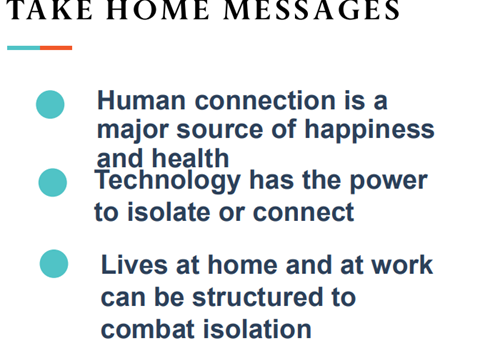
Translate this into an ECEC setting and the focus is on how we enable all babies and young children to have the nurturing relationships they need and how do we develop social and emotional skills through experiences, environments and relationships. Our settings need to be places rooted in love, safety and dignity where we develop children and staff, provide the social and emotional scaffolding required to form healthy relationships, resolve conflict and grow into adults capable of building loving partnerships, with families and the communities themselves. The messages to take away are:
I would reccommend reading his book, The Good Life and reconnecting with the Shaping Us Framework
I was delighted to sit on a panel at the Childcare Expo to discuss artificial intelligence (AI), a subject that has been gathering momentum across the media, not least…

Ofsted has responded to the Big Listen with changes to how future inspections are conducted. The report findings state that there was: A clear desire for more granular assessments of…

The 16th November marked Social Enterprise Day, so Happy Social Enterprise to you all. My dream is for every business to operate like a social enterprise and never have to…